
So Help Me God
What all fifty-four inaugural addresses, taken as one long book, tell us about American history
I. Exordium
By tradition, January 20 is the feast day of Saint Fabian, a third-century pope who was appointed in a most unusual way. Before 236, he was a simple layperson, leading an utterly obscure life, even by third-century standards. That year, Fabian came to Rome and found himself unexpectedly in the middle of a crowd choosing the successor to Pope Anteros, recently deceased. At a dramatic point in the proceedings, according to the chronicler Eusebius, a dove flew down from the ceiling and landed on Fabian’s head, in “clear imitation of the descent of the Holy Spirit in the form of a dove upon the Savior.” The rest of the story can be divined without too much difficulty: within moments, Fabian found himself nominated, elected, and handed the keys to the papacy. Surprisingly, he made quite a good pope.
Was the same invisible hand guiding Congress when in 1933 it switched the date of the presidential inauguration to Saint Fabian’s Day? It makes a certain cosmic sense, though one could argue that it made just as much sense to stick with the date on which our presidents were previously inaugurated—March 4. Not only was it enshrined in the Constitution (there are only twenty-five amendments to the Constitution, and two of them, the twelfth and twentieth, treat the date of the inaugural); it was also, by a stroke of founding genius, the perfect date for a rousing speech about the future (march forth!). But since 1937, when the new plan went into effect, we have been held to a tighter schedule, with the result that our quadrennial calendar begins in the short days of late January—hardly the best time to sing a song of renewal.
That does not appear to have dimmed our interest in the ceremony, however. Inaugurals happen rarely enough to be genuinely arresting spectacles. Once every four years, between the Olympics and the World Cup, we embrace the rituals that launch a new presidentiad—Whitman’s word. The parades, the seating charts, the jets streaking overhead, the swearing-in ceremony—and then, of course, the inaugural address, when the most powerful man in the world elucidates his vision for the next four years of history. What’s not to love?
II. Exposition
But it’s an odd moment, really. Very few states, with the possible exception of the Vatican, place such a high premium on the rituals attending the transfer of power. These elaborate ceremonies tease out a tension that is as present in the twenty-first century as it was in the eighteenth, when the United States was still an iffy proposition. Simply put, it is difficult to conduct a democracy without resorting to monarchical role models. The inauguration is of course a coronation, drawing heavily on medieval antecedents. There are traveling delegations from across the realm, elaborate hierarchies and protocols, balls, minstrels, horses, equerries—a veritable Renaissance Faire!
Yet it cannot be a coronation, so it is different. The new leader wears no crown (hats have been optional since 1960, when John F. Kennedy held a silk top hat but did not wear it). His tenure begins not with a religious ceremony symbolizing the church’s approval, but with the swearing of a legal oath, thirty-five words written very specifically into the Constitution—along with the four words ad-libbed by George Washington in 1789, “so help me God.” The ceremony that “makes a president” lasts only about six minutes, as the journalist Richard Harding Davis noted in 1897, while “six hours are required to fasten the crown upon the Czar of Russia and to place the sceptre in his hand.”
That tension continues throughout the day, when the new president is expected to walk some of the distance to the White House, waving jubilantly, but unable to walk free in any normal sense, surrounded by phalanxes of security men, bulletproof glass, and other interpositions between the theory and reality of democracy. And the tension continues throughout the presidency itself. An Irish carpenter I knew in Boston told me that the only image the Irish had of Ronald Reagan was that of a disembodied hand, sticking out of the back window of a Lincoln Continental limousine, waving good-bye as he sped away from the crowds that had come to see him. We have traveled a long way from the famous inaugural of 1829, when anyone could attend a White House reception, and did. Andrew Jackson was nearly crushed to death by the exuberant mob that showed up to congratulate him; he escaped by jumping out the nearest window.
The inaugural speech, the central spectacle of the day, remains sacrosanct, undiminished by the passage of centuries. It is unclear why, in fact, Washington felt compelled to speak at all on the day he launched the American presidency in 1789 (April 30, the only spring inaugural in our history). The very idea of an inaugural address was revolutionary—kings don’t persuade, they command. Monarchs have never been known for their eloquence, and certainly do not speak at coronations. To the extent that they ever give famous speeches, they give them on the eve of battle or at their own executions (Louis XVI’s moving address to the mob on the day he was guillotined took place four years after Washington became president). Indeed, Washington wrote a friend as he prepared to assume the presidency that he felt like “a culprit who is going to the place of execution.” But he was always saying things like that. In fact, he put immense effort into his inaugural address, turning to two friends (James Madison and David Humphreys) for help with the drafting. And the very act of speaking said something important about the new job he was filling: he needed the American people to hear him as he surveyed a new path into the wilderness. That speech set the precedent we still follow, fifty-four inaugurals later. It is the mold into which we pour our loftiest political language.
Why is the inaugural address so important? Surely part of the answer lies in the enormous expectations we freight the office with. We have very complicated, contradictory notions of who we expect our presidents to be. The leader of a political party…the symbol of the nation…the military commander-in-chief…the oracle, therapist, and self-empowerment guru for nearly 300 million people. With so many questions floating in the air about this father figure, we need the roots that a long speech, even a bad speech, can sink into the nation’s topsoil. The need isn’t uniquely American. Last October, the people of Indonesia were thrilled when their newly elected president, Susilo Bambamg Yudhoyono, gave a modest speech outlining his goals—something his predecessor never would have done. At their best, these secular sermons tell us where we have been, where we are going, and who we will be when we get there. It is curious that we expect the most important speech to come at the beginning of a presidency rather than at its crescendo or end. But undeniably, Lincoln’s two inaugurals, Roosevelt’s first, Jefferson’s first, and Kennedy’s rank among the most significant speeches in our history.
What was Washington thinking as he gave the inaugural inaugural? It is possible to put some of the pieces back together. We know that he felt keenly the tension between monarchy and democracy. His personal gravitas would not allow for the relaxed, telegenic public behavior that we now expect from our presidents; nor was he comfortable with the deification that was already under way in his lifetime. Before settling on “Mr. President,” the Senate debated a number of loftier honorifics, including “His Mightiness,” “His Serene Highness,” “His Elective Highness,” and “His Highness, the President of the United States, and Protector of the Rights of the Same.”
With his usual instinct for the correct solution, Washington groped toward a satisfying compromise. He validated democracy by going to Congress for the ceremony (in this case, Federal Hall in New York, a building at Broad and Wall Streets), and then, immediately afterward, by walking seven blocks to a church service, through a large crowd in lower Manhattan. He validated monarchy with his natural aloofness and his tolerance of regal adoration: the giant transparencies of the new King George, and the thousands of new objects designed with his image—tankards, watch fobs, buttons, and other cheap souvenirs, presidential customs that continue to this day, as a quick visit to eBay will confirm.
Of course, the inaugural tradition has grown, picking up piecemeal new rituals the way a shaggy dog accumulates burrs. The parade dates from 1829 when Andrew Jackson, trying to flee the huge crowds smothering him with affection, raced down Pennsylvania Avenue from the Capitol toward the White House and found that the crowd, to his horror, was following him. (This January, when you see the thousands of baton twirlers and tuba players following the presidential motorcade, think of them as slightly menacing, chasing after the chief executive in slow but high-stepping pursuit.) The White House reviewing stand dates from 1861, when a simple wooden platform with a canvas canopy was built for Abraham Lincoln to review the troops coming to defend Washington from the threat of invasion from the South.
The first inaugural address given in Washington was Jefferson’s, in 1801, famous both for its sound bite (“We are all Republicans, we are all Federalists”) and for its successful transfer of power from one party to another. When Jefferson spoke, so quietly that most of the room could not hear him, he was standing in the newly built Senate wing of the Capitol. In fact, that’s all there was to the Capitol; it was little more than a hallway in search of an idea. Looking at prints of the successive inaugurals in the early nineteenth century is almost a cinematic experience—only the building is the action figure. In each image, an indistinct president is in the foreground, giving an oration, while the Capitol gets a little bigger every time. It’s like flipping through children’s books with photographs arranged at the margins of the page in a time sequence, to create the illusion of film, or time, or both. Real photographs begin in 1857, with the inauguration of James Buchanan. The daguerreotype shows the washy effects of what was still a very sketchy chemical process—one person’s hat is far more distinct than the rest of his body, and focus is far better at the center of the image than at its margins, aptly symbolizing the aimlessness of the presidency as the United States drifted toward Civil War.
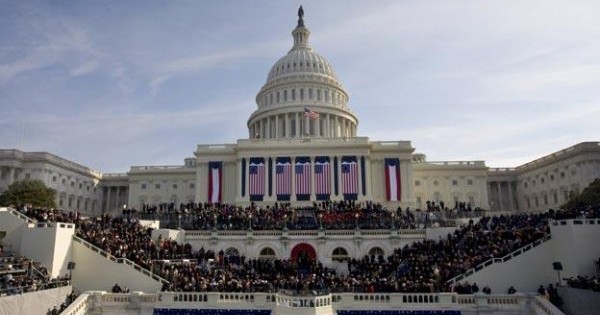
Four years later, we have a more focused photograph of Lincoln’s first inaugural, and four years after that, with the Capitol dome finally completed, we have a remarkable shot of Lincoln in the act of delivering his second. Historians argue about whether John Wilkes Booth is perceptible in the shot—nearly everyone looks like him—but the most fascinating figure is Lincoln himself, blurry and indistinct (did he move his head when he saw the photographer?), already growing spectral, as if he were inhabiting one of his legendary dreams about his imminent demise. This year marks the 140th anniversary of that oration, arguably the greatest in American history, and yet the basic appearance of the inaugural that will take place in 2005 would not surprise Lincoln’s audience. It’s all more or less the same, except that we now watch from the west front rather than the east, after Ronald Reagan shifted our viewing angle in 1981 (an actor’s privilege).
If, then, the inaugural address is an unusually American, unusually durable form of oratory, bringing the eighteenth and nineteenth centuries into our televisions, why do we know so little about it? Tens of millions will listen to George W. Bush on January 20, just as they did four years ago. But is there a single person, including the president, who can quote even a sentence from his 2001 inaugural address? Can anyone quote a sentence uttered since “Ask not what your country can do for you”?
III. Recitation
As a former presidential speechwriter, I used to spend more time than most looking into these matters. I once took it upon myself to read all of the inaugural addresses. It is not a task for the fainthearted. No one can enter those endless paragraphs about tariffs and civil-service reform and emerge undamaged. But if you’re going to do it, the library of the Old Executive Office Building in the White House complex is the right place—an extraordinary ironclad nineteenth-century space for books and bookworms, in what was once the State Department Library, where America’s treaties and founding documents were long kept under lock and key. There, those old speeches have new life breathed into them, and without too much difficulty, a reader can imagine the exhilaration with which America heard the earliest presidential thoughts of a Zachary Taylor, a Grover Cleveland, a Herbert Hoover. Taken all together, in sequence, the fifty-four inaugural addresses comprise an essential course in American history, a Book of the Republic, roughly 500 pages long, depending on your font size. Every four years, we can join those distant audiences and listen to the past’s plans for the future. It’s like stumbling across an old box full of nineteenth-century stereoscope slides at a yard sale, and wondering what those same images meant to the family that was transported by them to parts unknown.
Why would anyone in his right mind go through all of the inaugurals? I’m not sure what I was looking for, but finding those distant speeches and speechwriters was comforting at a lonely time for me, having been uprooted more quickly than I wanted to be from Boston and bewildered by late-1990s Washington, a world of policy wonks, cutthroats from both parties, and women still wearing shoulder-pad dresses from the Age of Reagan. To read through old catalogues of speeches offered a salve to my antiquarian soul, and I fell for the long-forgotten fables they held inside their crumbling bindings. Suddenly, I had forty-two new friends. The old presidents generously shared their fears, their hopes, and their most personal aspirations for the country of which I, too, was a citizen. More than mere politicians, they were storytellers, each writing a narrative that improved upon his predecessor’s.
It’s a surprisingly common urge to go back to the beginning. Instead of saying simply, “I have been elected president and these are my plans for the next four years,” most said something like, “Because I’ve been elected, I’m going to tell you the story of democracy, and why America is the greatest country.” That can be instructive—when John Adams reflects upon the Revolution and the Constitution, it’s worth listening. It can also be pedestrian in a lesser figure (say, James Monroe). There is a thin line between a cliché and a genuinely moving statement about a personal belief or experience. Nevertheless, I developed a fondness for both, and grew to enjoy the curious awkwardness that bedeviled past presidents at the precise moment of their elevation, as if the dizzying height to which they had climbed also deprived them of much-needed oxygen.
There are so many to choose from. Why did John Adams, sailing along smoothly, suddenly embark on an interminable single sentence that took up approximately a quarter of his address and required 732 words to complete? (Yes, I counted.) Why did Martin Van Buren include an exclamation point—the only one in inaugural-address history—after a sentence that was neither funny nor shocking? What inner child in George H. W. Bush forced him to say “freedom is like a beautiful kite that can go higher and higher with the breeze”? Was Warren Harding reading skin-care ads when he urged Americans to free themselves “from the great blotches of distressed poverty”? Why did John F. Kennedy, usually so smart, wonder if “a beachhead of cooperation may push back the jungle of suspicion”? What was Nixon thinking when he ripped off Kennedy by saying, “Let each of us ask—not just what will government do for me, but what can I do for myself?” Was Reagan daydreaming of Mitch Miller with his odd paean to “the American Sound”?
Even without obvious clunkers, many of the addresses are stunningly dull. The three worst are Taft’s (as fat as its author), McKinley’s (a typical topic sentence: “The question of international bimetallism will have early and earnest attention”), and William Henry Harrison’s interminable excursus into ancient Roman history. Harrison took an hour and forty minutes to read his speech, in a snowstorm, and that was after Daniel Webster had streamlined the original version (“I have killed seventeen Roman pro-consuls as dead as smelts,” he wrote a friend). Some felt that it was divine retribution when Harrison died a month later from an illness he contracted during its delivery. Calvin Coolidge also deserves an honorable mention—he was hardly “Silent Cal” while droning on about patriotism during a very long address (“We have been, and propose to be, more and more American”).
Of course, we err in applying modern standards of literary quality to what was neither modern nor literary. A speech is not a poem or even an essay; it is a highly ritualistic kind of theater that combines words, gestures, and backdrops to create a stylized effect. As with Japanese kabuki, the audience derives much of its pleasure from its knowledge of the ritual. In our modern world of rapid sensations, we frown upon hearing any thought we have heard before; but such repetition was reassuring to earlier American audiences. It’s clear that verbosity, far from being a sin, was a positive virtue for the people who assembled every four years to hear these elaborate performances. John Quincy Adams’s first sentence, while unreadable today, must have thrilled a certain kind of listener: “In compliance with an usage coeval with the existence of our Federal Constitution, and sanctioned by the example of my predecessors in the career upon which I am about to enter, I appear, my fellow-citizens, in your presence and in that of Heaven to bind myself by the solemnities of religious obligation to the faithful performance of the duties allotted to me in the station to which I have been called.” What writing class could ever teach that? Of course, they also liked laudanum and enemas in the nineteenth century.
And there is a problem worse than swollen writing. The urge to write at great length is often tied to the need to conceal something, and there were unmentionable parts of the American story that never made it close to the inaugural stage. In their haste to please, nearly every early American president went to great lengths to avoid the word slavery, preferring tortured euphemisms like “domestic institutions” or no mention at all. One cringes a bit when James Monroe asks, gloatingly, “On whom has oppression fallen in any quarter of our Union? Who has been deprived of any right of person or property?” In 1857, on the eve of the Civil War, James Buchanan wanted to end the argument over slavery so that he could move on to “more pressing” matters, like the spread of “liberty throughout the world”! It’s no wonder that their contemporary Herman Melville wrote, “Woe to him who seeks to please rather than to appall.”
The kabuki of the typical inaugural can be broken down into specific set pieces; the thoughts arranged in a comforting sequence that would have been instantly familiar one hundred, even two hundred, years ago.
1. I am not worthy of this great honor.
2. But I congratulate the people that they elected me.
3. Now we must all come together, even those of us who really hate each other.
4. I love the Constitution, the Union, and George Washington.
5. I will work against bad threats.
6. I will work for good things.
7. We must avoid entangling alliances.
8. America’s strength = democracy.
9. Democracy’s strength = America.
10. Thanks, God.
Not every speech follows that scheme. But quite a lot do. Still, a few inaugural addresses jump out from behind the damask curtain of nineteenth-century sensibilities. Who knew that James Garfield was a passionate champion of the rights of ex-slaves? Or that Rutherford B. Hayes daringly called for the creation of a single six-year term for the president? Or that Benjamin Harrison, another Republican beard, was a sensitive writer?
And there is something about the generals that compels admiration. Military exigencies pruned their writing styles long before they entered politics. Washington’s second inaugural is all of 135 words—about what it would take Taft to clear his throat. Jackson says more in fewer words than any of his contemporaries. Grant weeds out needless adjectives like so many Confederate sharpshooters: After discussing Reconstruction and problems with black suffrage, he clenches his jaw and says, “This is wrong, and should be corrected.” What else is there to say? Grant’s no-nonsense style is even more appealing when one learns that halfway through his speech, his young daughter, lonely, came up to the podium to hold his hand while he was speaking. Doubtless he was lonely too.
These human moments are not written into the Messages and Papers of the Presidents, a ten-volume collection of presidential utterances between 1789 and 1897 that was the standard source for generations. But they too are an inexorable part of the story. Should we not know that James Garfield suffered from crippling writer’s block and simply could not finish his speech until 2:30 on the morning of the inaugural? As the day approached, he had an anxiety dream in which he fell off a canal boat and was suddenly standing naked in the wilderness during a wild storm. After finding a few pieces of cloth to cover himself and embarking on “a long and tangled journey,” he found his way to a house where “an old negro woman took me into her arms and nursed me as though I were a sick child.” Comforted, he awoke to face his presidency.
If there is a single theme that unites all of the inaugurals, from George W. to George W., it is the need to explore the central mystery of God’s relationship to the American experiment. This is hardly a simple topic, and some handle it better than others. John Quincy Adams preferred to place his hand on the Constitution rather than the Bible. Dwight D. Eisenhower, on the other hand, allowed a vehicle called “God’s Float” to enter his parade. A religion writer compared it to “an oversized model of a deformed molar left over from some dental exhibit.”
The tradition, as I noted earlier, goes back to Washington’s spontaneous decision to blurt out “So help me God” in 1789. From that moment on, God was in the details, or more specifically the concluding paragraph. There, time and time again, He appears to bless the proceedings. The mere mention of His name signals the imminent end of the speech, as if the manager of a vaudeville house had appeared onstage to thank the audience and urge its members to gather their belongings before leaving. God appears in forty-two of fifty-four perorations, and only one speech dares to leave Him out completely—Washington’s second inaugural. The conformity ends, however, when it comes to naming Him. The founders avoided invoking God by name and instead resorted to a dizzying array of divine identifiers: “the benign Parent of the Human Race” (Washington), “that Being who is supreme over all” (Adams), “that Infinite Power which rules the destinies of the universe” (Jefferson), “that Power whose providence mercifully protected our national infancy” (Jackson), and “Him Who has not yet forsaken this favored land” (Lincoln). It is worth noting that Jesus has never been mentioned in an inaugural address.
Lincoln remains aloof from the rest, fascinating, slightly subversive. From fourth grade on, we are trained to think him great, without really knowing why, except that he freed the slaves and won the Civil War. But to read Lincoln in the context of his surrounding inaugurals is to see a gifted genius so ahead of his time that we are still in some ways catching up to him. For him, religion, like patriotism, was not a boast to be brayed in public, but an aspiration to be quietly, relentlessly sought in the dark chambers of the human heart.
Each of Lincoln’s inaugural addresses struck the perfect tone for its moment. An eyewitness to the first (1861), Benjamin Brown French, wrote, “words could not have been selected & framed into sentences that could better express the ideas of those who have elected Abraham Lincoln to the Presidency.” With a lawyer’s precision and a friend’s patience, Lincoln pleaded the cause of the Union with the South and reminded them, delicately but firmly, how much was at stake (he artfully delayed the words “civil war” until the penultimate paragraph).
The final paragraph is a miniature masterpiece and still teaches editors and aspiring speechwriters what a few line changes can do to strengthen an argument. William Seward, the incoming secretary of State, proposed these lines:
I close. We are not we must not be aliens or enemies but fellow countrymen and brethren. Although passion has strained our bonds of affection too hardly they must not, I am sure they will not be broken. The mystic chords which proceeding from so many battle fields and so many patriot graves pass through all the hearts and all the hearths in this broad continent of ours will yet again harmonize in the ancient music when breathed upon by the guardian angel of the nation.
Lincoln’s translation:
I am loath to close. We are not enemies, but friends. We must not be enemies. Though passion may have strained, it must not break our bonds of affection. The mystic chords of memory, stretching from every battle-field and patriot grave, to every living heart and hearth-stone, all over this broad land, will yet swell the chorus of the Union, when again touched, as surely they will be, by the better angels of our nature.
Lincoln’s second inaugural (1865) is more majestic still. Though one of the shortest inaugurals, it remains the best. Everything about it is different—its lack of interest in the minutiae of politics, its stately retelling, in short, lapidary building blocks, of the war’s story. The remarkable four-word sentence, “And the war came,” surely preceded by a pause when he spoke it, seems almost to have sprung from the Old Testament. The brilliant disquisition on God’s indecipherability (“The Almighty has his own purposes”) flies in the face of all presidential oratory before and since. This least hermeneutic of all inaugurals is also in many ways the most religious, offering searing passages from the Bible along with Lincoln’s mystical reflections on human responsibility to a God that is not always responsive, even to Americans. Finally, it is a literary gem, containing small surprises around every corner, including this prose poem near the end:
Fondly do we hope,
Fervently do we pray,
That this mighty scourge of war
May speedily pass away.
There are countless inaugural highlights in the more crowded twentieth century. Wilson’s musings are cerebral and eloquent, befitting a parson. FDR is interesting four times in a row—no mean feat—and breaks down the distance between speaker and listener with colloquialisms (“thank God”), sound bites (“fear itself”), and contagious optimism. Eisenhower’s second, while unknown to most, bears a close rereading today for its shrewd assessment of imperial overreach. JFK was our most exciting inaugural speaker, and no one should discount the importance of the way the words are performed—in his case, barked out on a day so cold that you could see wisps of air escaping from his mouth, like smoke from a dragon ready to slay the hoary Washington establishment seated behind him. Kennedy could have read any president’s inaugural and made it mean something. But his words were of course well chosen. Ted Sorensen, his speechwriter, studied Lincoln’s Gettysburg Address, and noticed something that had eluded almost all presidents in between: Lincoln communicated big ideas with very small words. Accordingly, he began lopping off adjectives and syllables to stunning effect (speechwriting can be a science as well as an art). The use of the second person (“ask not what your country can do for you…”), rare in presidential oratory, was another bright innovation. Eisenhower used Thou in 1953, but he was speaking to God at the time.
Still, none of the great speeches of the last century has quite the
audacity of Lincoln’s second, which becomes more revolutionary as modern politicians increasingly claim that God approves their actions. Despite Washington’s impetuous decision to kiss a borrowed Masonic Bible in 1789, I suspect that the founders—all creatures of the Enlightenment—would find the current evangelical climate dispiriting.
IV. Peroration
In the greatest essay on speechwriting ever written, “Politics and the English Language” (1946), George Orwell warns against the subtle and serial ways in which stately language can be placed in the service of violence. Obviously, Orwell deplored Nazism and Stalinism, but he was equally discouraged by ways in which Western politicians resorted to euphemism, stale imagery, and over-reliance on safe words like democracy to obscure policies he disliked (including British rule in India and the dropping of the atomic bomb on Japan). “Political language,” he wrote, “is designed to make lies sound truthful and murder respectable.” Orwell would particularly hate the word Orwellian, which has become untethered from its moorings, like a runaway dirigible, and now means anything dark and threatening.
How would this shrewd judge of language evaluate our modern rhetoric? I doubt it would be pretty. Orwell would approve President Bush’s reliance on short, sturdy Anglo-Saxon words. But he would deplore his helpless dependence on extremist words, both negative (evil, terror) and positive (freedom, liberty, democracy), that conjure emotions rather than facts, and round up people and nations into good and bad corrals like so many cattle. Even at the height of World War II, fighting a far more lethal enemy, FDR paused frequently to define the kind of democracy America was fighting for. But today, our words seem to lose precision as our weapons acquire it. It was a telling moment when veterans of the Afghanistan and Iraq conflicts rejected the Global War on Terror medals they had received from the Pentagon, in favor of separate medals for the two very different campaigns they had fought in. The American people are surely capable of understanding the complex nuances of these difficult struggles—political, diplomatic and military. We deserve to be spoken to as equals.
No one knows what the fifty-fifth inaugural address—January 20, 2005—will offer Americans and the people of the world (they, too, care deeply about the words spoken by American presidents). President Bush has a gift for connecting with his audiences, or he would not be ascending the podium for a second time. We can all hope that he uses this opportunity to say clearly, without artifice, what Americans need to hear about our next four years. It goes without saying that we like soothing phrases about the remarkable nation we all inhabit. But we also need concrete, grounded ideas about America’s place in the world. More than anything, we need to reconnect to each other as fellow Americans, to borrow a favorite presidential phrase. A century and a half ago, that is precisely how Lincoln reached the summit of the inaugural tradition.
Given how venerable the inaugural tradition is, it is becoming more difficult to claim, as so many presidents have, that we are a very young country. We are more like an aging movie star who needs a couple extra minutes to apply her makeup. “Getting old ain’t for sissies,” as Bette Davis said. But age has its compensations, not the least of which is that our history just keeps getting better. The inaugural ceremony is already crowded enough, but for me there will be forty-two other presidents on the platform, adding their voices to the sounds of the ceremony and straining to “harmonize in the ancient music,” to use Seward’s discarded phrase. Surely it does no harm to pause for a moment and listen to what they have to say, still speaking to us faintly over the din of the republic.